
Global Breaking News - Sunday, September 27, 2026








   |
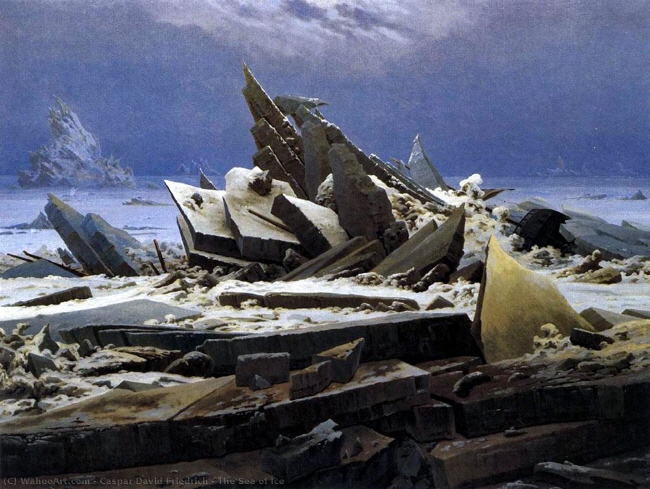
[Misc] (Top 100 Paintings - 019) The Sea of Ice by Caspar David Friedrich
최고관리자 | 20-02-13 08:48
(1) "Write 2 Speak 전체 목록 & 모든 콘텐츠"를 보시려면 "Write 2 Speak = 유튜브 채널"에
가입(subscribe - 클릭)후 "본인의 유튜브 ID & Write2Speak 등록 ID"를 "write2speak@daum.net"로
이메일로 보내 주시면 확인 후 본 사이트 정회원으로 등급됩니다. 많은 신청 기다리겠습니다.
(2) 참고로, "Write 2 Speak"에 올라오는 유튜브 contents는 정기적으로 삭제가 되며, "전체 내용"을 보시려면
위에 절차를 따라야만 "Write 2 Speak -> 자료실(클릭)"영역에서 모든 내용을 다시 볼 수 있습니다.
****************************************************************************************
The Sea of Ice by Caspar David Friedrich
The Sea of Ice (German: Das Eismeer), also called The Wreck of Hope (German: Die gescheiterte Hoffnung) is an oil painting of 1823–1824 by the German Romantic artist Caspar David Friedrich.
The landscape depicts a shipwreck in the middle of a broken ice-sheet, whose shards have piled up after the impact. The ice has become like a monolithic tomb, or dolmen, whose edges jut into the sky. The stern of the wreck is just visible on the right. As an inscription on it confirms, this is HMS Griper, one of two ships that took part in William Edward Parry's 1819–1820 and 1824 expeditions to the North Pole.
The two titles originally referred to the present work and another older work by Friedrich, now missing. The lost painting was shown in 1822 at the Dresden Academy exhibition under the title A Wrecked Ship off the Coast of Greenland in the Moonlight. Own Invention. The present painting was first shown in 1824 at the Prague Academy exhibition under the title An Idealized Scene of an Arctic Sea, with a Wrecked Ship on the Heaped Masses of Ice.
In Friedrich's estate this work was described as Ice Picture. The Disaster-stricken North Pole Expedition. The collector Johann Gottlob von Quandt commissioned two pictures that were to symbolize the south and the north. Johann Martin von Rohden received the commission to paintSouthern Nature in her Abundant and Majestic Splendor, while the commission for Northern Nature in the whole of her Terrifying Beauty fell to Friedrich. However, as Schukowski in a letter dated 1821 reported, Friedrich - himself does not even know what he will paint he waits for the moment of inspiration, which (in his own words) occasionally comes in a dream.
Accounts of expeditions to the North Pole were occasionally published during those years which is likely how Friedrich became familiar with William Edward Parry's 1819–1820 expedition to find the Northwest Passage. In the winter of 1820–21, Friedrich made extensive oil studies of ice floes on the river Elbe, near Dresden. These were probably incorporated into The Sea of Ice.
|
|